General News

Expedition leader, H. G. Watkins climbing on floe from kayak.

Back in 1930 UK explorer, H.G. Watkins (the guy in the photo above) gathered a team together to see if a new air route between Britain and Canada could be established rather then flying across the dangerous ocean. The proposed route was to cross the Arctic via the Faroes, Iceland, Greenland, Baffin Island and Hudson Bay before reaching Winnipeg.

Along with figuring out the route, the 14-man team had a goal to map the very poorly understood Greenland shoreline as well as gather climate data of the icecap of Greenland during the polar winter.

All in all the year-long expedition was quite a success and it have some slow times allowing the team to take some kayak lessons from the local people living in Greenland.

The footage below was captured in the summer of 1930 and shows members of the expedition in the last half.

Two interesting observations from the film; first, it’s clear towards the end of the footage, it’s team members rolling and playing around in the boats so they must have had enough time (and willingness to get wet) to actually learn how to roll. Could these be one of UK’s first people to learn how to roll a kayak? Not sure.

The second thing I realized that even 82 years later, as soon as a group of kayakers who can roll get together somebody always wants to organize some sort of synchronised rolling demonstration.

Of course not everything on the expedition went smooth. During the winter of 1931, Augustine Courtauld volunteered to live solo at the weather station in the interior of Greenland for five months and take weather measurements.

Freeze Frame has a better description of his adventure then I could ever make up:

Having left his spade outside [the station], Courtauld had struggled with the snow, it had filled both the exit and the openings into the snow house and stores. He had also been troubled by the loss of paraffin from two slightly punctured tins, this resulted in a shortage of fuel and as he also ran out of candles he had to spend some time in the dark. He also ate his meals uncooked so that the limited supply of fuel could be conserved to melt drinking water.

More info and fantastic photos can be found here.

Update: Upon further investigation, I found out that expedition leader, G.H. Watkins went back to Greenland in 1932 on a second expedition which would sadly end in tragedy for him.

During both the 1930 and 1932 trips to Greenland he spent a lot of time with the local people becoming quite proficient at kayaking. In fact he fell in love with the activity and people so much that the expedition was one of the first to make use of indigenous techniques and methods. He and his men were so at hunting seals from a kayak that they planned on not bringing any food for their 1932 expedition but rather live off the land completely. At the time this was completely unheard of especially by citizens of British society who looked down at the people of Greenland as savages.

Sadly the method of travel for the expedition wasn’t to come about as Watkins drowned in his kayak while he was out hunting on his own one day.

G.H. Watkins legacy to polar exploration was a real shift in mindset in how future expeditions are carried out; as well he planted the seeds of respect for the local people. It’s best described on the very fascinating site, Freeze Frame:

This expedition marked a real shift in the way explorers viewed indigenous technologies. Apart from following in Nansen’s footsteps in adopting the sledge and snowshoe designs [Watkins] adapted from Inuit versions during the periods in which he overwintered with them, few explorers had wholeheartedly examined and embraced Inuit survival techniques. Watkins’ final expedition, for which the food source was based entirely upon Inuit hunting methods, marks the start of changing views with regard to the Inuit and their techniques.

If you are an adventurous soul living in the UK or Ireland and thinking of organizing a big adventure in 2013 you should make note and apply for the Kukri Adventure Scholarship.

The Kukri Adventure Scholarship is a brand new program aimed at providing up to £20,000 in funding to help get your trip off the ground. Along with the cash you also get a pile of free gear as well which is fantastic.

Entering into the contest involves first coming up with a fantastic idea then making a short two-minute video to sell the idea to the judges and the public on Facebook.

The cool thing about the scholarship is that your level of expertise or fame isn’t a factor in winning but rather your ability to think up a good adventure, able to carry it out and bring back a good story to tell the world.

More info: Kukri Adventure Scholarship
Photo Credit: kukrievents.com

Here is your inspirational story of the day:

Meet the 91-year-old kayaker, Louise Sheldon.

Back in mid-August the staff of Independence Village, a retirement home in Aurora, Ohio decided to organize a day of kayaking for the residents. The plan was to put everybody in the bow of double kayaks and volunteers would paddle them down the river.

Louise Sheldon decided she was going to have none of that and at 91 decided to paddle the five mile stretch by herself, and in her own kayak.

Of course the staff at the retirement home didn’t she could do it but even though she hadn’t been in her kayak for almost a year she has been paddling canoes and kayaks her whole life.

"I wasn't sure how far I'd go, but I went the whole five miles," she said. "We had fun. That's what counts. I just loved it. I wanted to keep going."

Allison Tucker, the facility's activities director said, “Because the river was so low, Louise got stuck a couple of times and worked her way out of it all by herself. She is amazing.

If you were to ask Louise what her best trip was, she would tell you about the time they paddled down the Cuyahoga River (about 85 miles) back in 1959. It wasn’t a crazy mile trip as they broke it up over eight or nine days but back then four woman paddling down the river by themselves was so unheard of that it landed them front page in the local paper.

So here is to Louise Sheldon and her passion to keep exploring. Keep it up for another 10 years and I will write another article about you.

More info: auroraadvocate.com
Photo credit: auroraadvocate.com

A flasher

It looks like kayakers on the Pinnebog River (located in the thumb part of Michigan) have been having so many problems with flashers lately that local police decided to set-up a sting operation and try to catch the perv who has been showing of his wing wang in public.

Well their trap worked and they caught somebody.

NY freelance TV producer William H. Masters III—son of Masters and Johnson sex researcher William Masters—was allegedly caught dangling his ding dong at two undercover cops who were merely posing as kayakers as part of a sting operation.

According to the Post, the incident occurred nearby on the Pinnebog River near Masters' Michigan family vacation cottage on Saturday. The Huron County sheriff’s office said “a 60-year-old New York City-area man yelled for [the] attention” of two women kayaking by. He was on the shore and “was completely nude and making obscene gestures.” But the kayakers were actually “part of a combined law-enforcement-agency sting operation, working out of a two-person kayak on the river.”

Masters was released on a $5,000 bond and faces up to two years in jail on aggravated indecent exposure.

More info: gothamist.com

PS – Yep, I totally stole the headline from the gothamist.com user, Wasseka who posted the idea for the headline on the site.

Photo credit: guardian.co.uk

Ask ten people who live in Ontario where the best places are to go kayaking and you will probably get ten different answers. The opportunities for sea kayaking in Ontario are virtually endless and deciding where to go can be a bit daunting if you don’t already know the area. To help you get started, check out dealchecker. They can help you find the kayak or canoe holiday (as well as flights to Canada) that you are seeking.

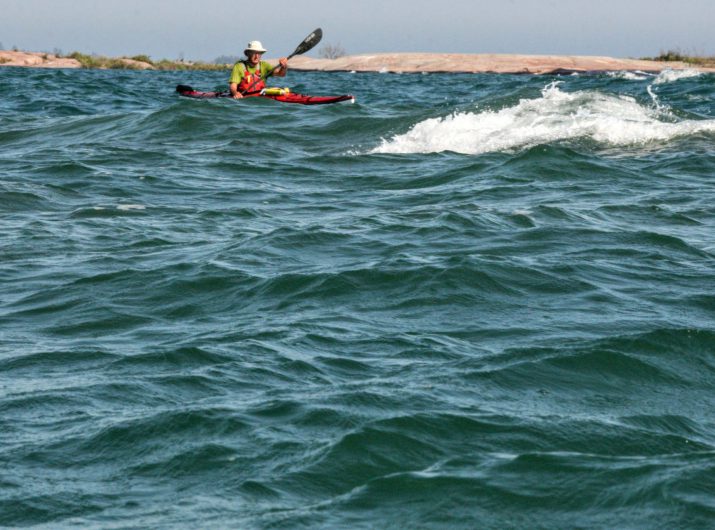
Ontario borders four of the five Great Lakes which is one of the reasons it’s such a fantastic place for sea kayakers looking for adventure. Generally speaking, the two best lakes for sea kayaking are Lake Huron (in particular Georgian Bay) and Lake Superior. Both locations offer hundreds of miles of undeveloped shoreline and crystal clear water.

Georgian Bay, Lake Huron

Georgian Bay is one of the classic Ontario destinations for sea kayakers. It’s an area known as the 30,000 islands and a huge amount of the shoreline is still undeveloped giving you the wilderness experience you are looking for.


View Larger Map

The geography of Georgian Bay is very unique. During the last ice age that area of the Canadian Shield was scraped down by the retreating glaciers leaving behind campsites made of solid, smooth bedrock. This makes the area a perfect spot for kayak trips as you are not camping on sand or mud and the shoreline is free of weeds for swimming. Those are all good things in my book.

DSCN0339 ep

As far as trip routes to paddle in Georgian Bay, you have lots of options. The jumping off point for most people is at the many marinas just outside of Parry Sound. You can leave from the marina in Snug Harbour, Dillon Cove or Point au Baril for example and from there either paddle north or south along the shoreline. If you are looking for less people, plan your trip to get out to the many off-shore islands along its length. There will be a lot less boat traffic and cottages out there.

Getting to Georgian Bay isn’t that difficult for international travelers as you can fly directly into Toronto and a hire a car from a car for the 2.5h drive north to Parry Sound. From there you can access several outfitters who offer everything from boat/camping gear rentals all the way up to fully guided trips. Talk to White Squall Paddling Centre, Black Feather or Learn to Kayak. Wild Women Expeditions is a unique business that runs woman only trips out of the Georgian Bay area so you should contact them if you are looking for that sort of thing.

Lake Superior

When it comes to sea kayak paddling locations in Ontario, the north shore of Lake Superior is the undisputed king and often voted as one of the most beautiful places to paddle in Canada.


View Larger Map

The one thing to keep in mind is that paddling along Lake Superior is not for the faint of heart. With cold water and big waves due to high winds, you need to plan a trip on Lake Superior like you were planning a trip on any ocean. You should have fair bit of experience kayaking and camping if you are planning your own expedition. That being said, there are lots of excellent locations that beginner can visit when accompanied with a proper guide to help out.

At the East end of the lake international travelers can fly into Thunder Bay and use that location as the start for adventure with many excellent trips along the north shore. Sleeping Giant Provincial Park or Slate Islands are both excellent places to go with a guide.

Another very nice place to paddle that is also logistically easy to get to is Lake Superior Provincial Park along west shore between Wawa and Sault Ste. Marie. Lake Superior Provincial Park offers a coastline that is about 120 kilometers (75 miles) long which is a very nice 5-7 day paddle. Just remember that the shoreline has several sections of large cliffs or inaccessible shoreline so make sure that you stay off the water when the wind is blowing as it can get very rough very quickly. June and July are the calmest months so plan your trip during that time.

There are several outfitters on Lake Superior who can help you with logistics including gear/boat hire, vehicle shuttles, or guided trips. Contact Naturally Superior Adventures, Superior Outfitters, Caribou Expeditions or Wildwaters for more information.

As you can see, Canada offers an unbelievable number of paddling opportunities and we haven’t even scratched the surface yet. British Columbia, Quebec, Newfoundland, Nova Scotia all offer amazing destinations as well. If you are interested in a canoeing holiday there are so many rivers in the interior of Canada that you can’t even count them all on one hand.

Top photo credit: DSCN0339 ep | Eric.Parker Attribution-NonCommercial 2.0 Generic / CC BY-NC 2.0
Bottom photo credit: Lake Superior Provincial Park | Andrea Schafferhttp://creativecommons.org/licenses/by/2.0/deed.en_CA / CC BY 2.0

Get our Newsletter


Find Us on Facebook

Solo Stove Ad

About Me

David standing on a boat. Photo credit: BirgitDavid H. Johnston
Toronto, Ontario, Canada
View my complete profile

"Bring a compass, it's awkward when you have to eat your friends."

Strategic Partner

Paddle Canada Logo

P&H  Logo Werner Paddles Kokatat Logo North Water Aquapac Logo Seals Logo