Update: Sorry kids, the boat is sold.
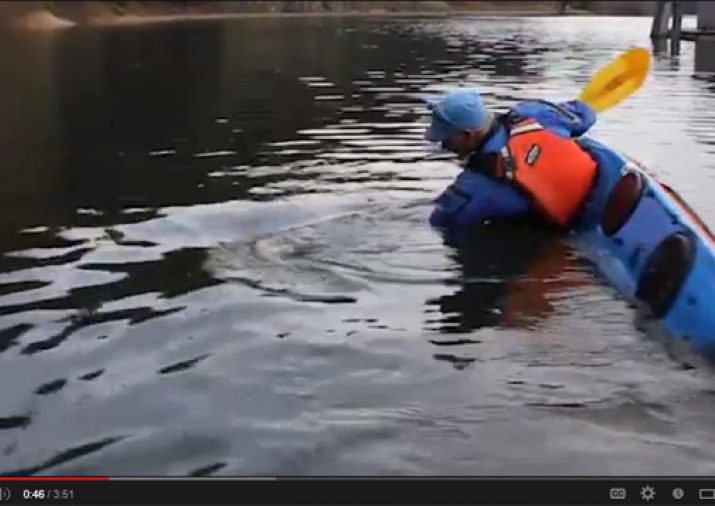
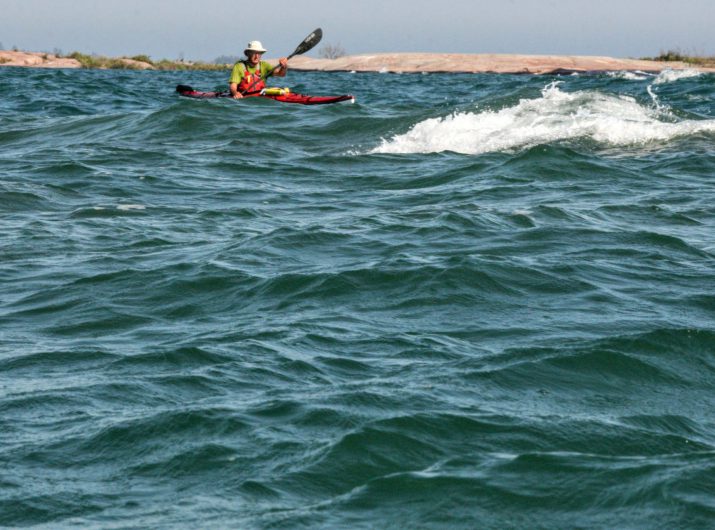
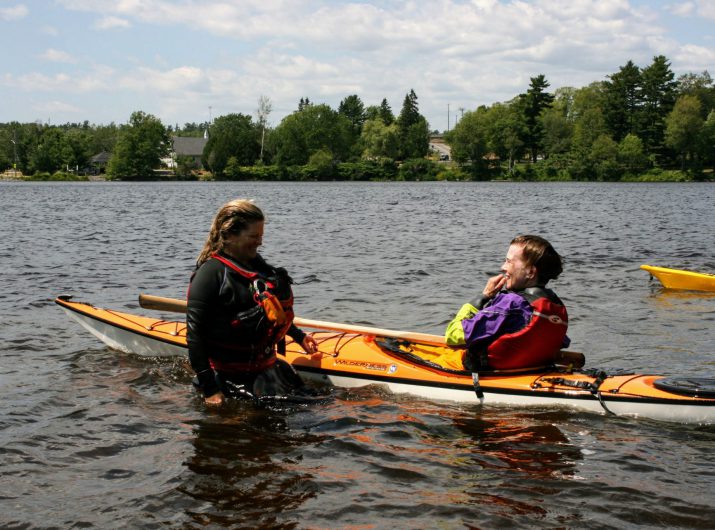
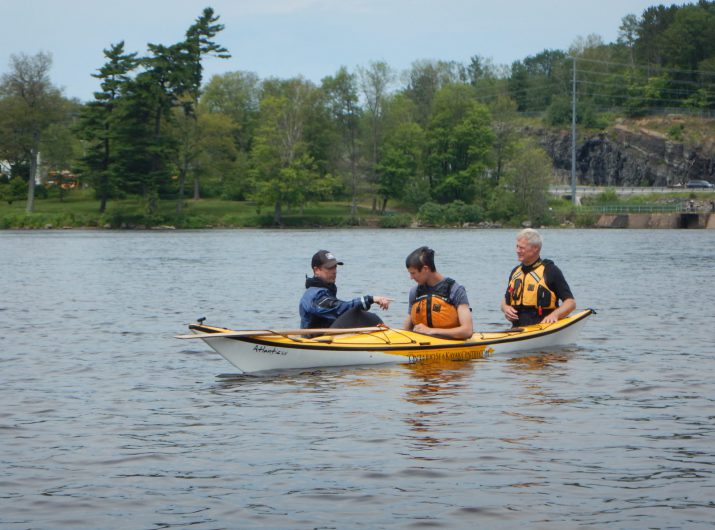
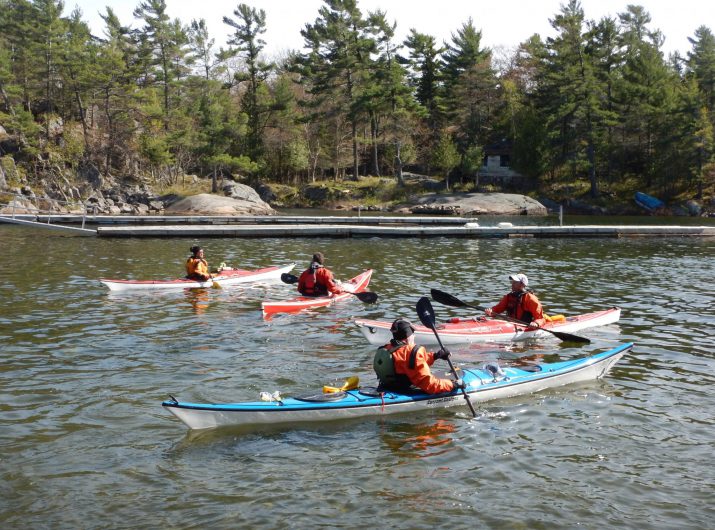
You are looking at one of the greatest kayaks ever built and it could be yours for only $800 firm. Behold the Slipstream designed by the late, great Derek Hutchinson and manufactured by Current Designs.
The slipstream is 10 years old and she has taken me all over Georgian Bay and

This boat has been highly customized over the years including:
I will be straight up with you; I wouldn’t describe this baby as like-new or even in newish condition. The fact is she is well used, so if you are looking for a scratch free boat, keep looking. There are a couple of minor chips in the fibreglass here and there but there are no structural cracks in the hull or anything like that.

She is still a fine boat with years of life still in her.
Please note that with the custom bulkhead it is going to be a tight fit for anybody with an inseam longer than roughly 32”. It’s possible to cut out and move the bulkhead if you find the fit too tight for your monster long legs.
The boat is located in downtown
If you are looking to purchase your first kayak and looking for a high performance boat at a cheap price, you found her.
If you want to see the full collection of photos in high resolution click here.
Interested? Email me This email address is being protected from spambots. You need JavaScript enabled to view it. .
Update: Sorry kids, the boat is sold.

Back in 1930 UK explorer, H.G. Watkins (the guy in the photo above) gathered a team together to see if a new air route between Britain and Canada could be established rather then flying across the dangerous ocean. The proposed route was to cross the Arctic via the Faroes,
Along with figuring out the route, the 14-man team had a goal to map the very poorly understood Greenland shoreline as well as gather climate data of the icecap of
All in all the year-long expedition was quite a success and it have some slow times allowing the team to take some kayak lessons from the local people living in
The footage below was captured in the summer of 1930 and shows members of the expedition in the last half.
Two interesting observations from the film; first, it’s clear towards the end of the footage, it’s team members rolling and playing around in the boats so they must have had enough time (and willingness to get wet) to actually learn how to roll. Could these be one of
The second thing I realized that even 82 years later, as soon as a group of kayakers who can roll get together somebody always wants to organize some sort of synchronised rolling demonstration.
Of course not everything on the expedition went smooth. During the winter of 1931, Augustine Courtauld volunteered to live solo at the weather station in the interior of
Freeze Frame has a better description of his adventure then I could ever make up:
Having left his spade outside [the station], Courtauld had struggled with the snow, it had filled both the exit and the openings into the snow house and stores. He had also been troubled by the loss of paraffin from two slightly punctured tins, this resulted in a shortage of fuel and as he also ran out of candles he had to spend some time in the dark. He also ate his meals uncooked so that the limited supply of fuel could be conserved to melt drinking water.
More info and fantastic photos can be found here.
Update: Upon further investigation, I found out that expedition leader, G.H. Watkins went back to Greenland in 1932 on a second expedition which would sadly end in tragedy for him.
During both the 1930 and 1932 trips to Greenland he spent a lot of time with the local people becoming quite proficient at kayaking. In fact he fell in love with the activity and people so much that the expedition was one of the first to make use of indigenous techniques and methods. He and his men were so at hunting seals from a kayak that they planned on not bringing any food for their 1932 expedition but rather live off the land completely. At the time this was completely unheard of especially by citizens of British society who looked down at the people of Greenland as savages.
Sadly the method of travel for the expedition wasn’t to come about as Watkins drowned in his kayak while he was out hunting on his own one day.
G.H. Watkins legacy to polar exploration was a real shift in mindset in how future expeditions are carried out; as well he planted the seeds of respect for the local people. It’s best described on the very fascinating site, Freeze Frame:
This expedition marked a real shift in the way explorers viewed indigenous technologies. Apart from following in Nansen’s footsteps in adopting the sledge and snowshoe designs [Watkins] adapted from Inuit versions during the periods in which he overwintered with them, few explorers had wholeheartedly examined and embraced Inuit survival techniques. Watkins’ final expedition, for which the food source was based entirely upon Inuit hunting methods, marks the start of changing views with regard to the Inuit and their techniques.

A couple of months ago we talked about how Boreal Design had gone bankrupt leaving kayak company, Maelströmkayak in the lurch as Boreal Design was building their boats.
It looks like Maelströmkayak is quickly getting back on their feet. I got a note today from company President, Charles-Alexandre Desjardins explaining what’s happening over the next couple of months.
First off they have a new website that is supposed to go live any day now. Though a new website will be great to see, the current photo that is on the site current is awesome and better be part of the new design.
I’m told that when the new site goes live we will learn more details about two new boat designs that should be available for Spring 2013 (or hopefully earlier). The two new boats are going to be 16’6” x 21” and 17’7” x 21.5” beam. The solid design details are sketchy right now so we will need to wait until we see better photos of what the boats look like. Here is a tease drawing of what to expect.

Charles-Alexandre had this to say about what’s to come:
The names of the new models will be disclosed on our website, but you can expect a Scandinavian inspiration. We are pushing the envelope a bit with the new designs, with features quite unique. The decks are not designed for carrying all your stuff on them and in my mind, you should only carry a spare paddle, compass and water pump. All the rest should be in the boat or on you. You'll see what I mean.
So two new boats, for expedition and fun in the surf zone. One for small to medium size paddlers and the other one will be for larger paddlers. Great color combination will be made possible with our unique and distinctive hull's wing.
They are planning to test the prototypes this July and August and if the designs hold up, they will be manufactured at a factory in Quebec which is great to hear.
Time will tell what we will get. I’m just glad to see them getting back on their feet after taking quite an unexpected beating this past spring.
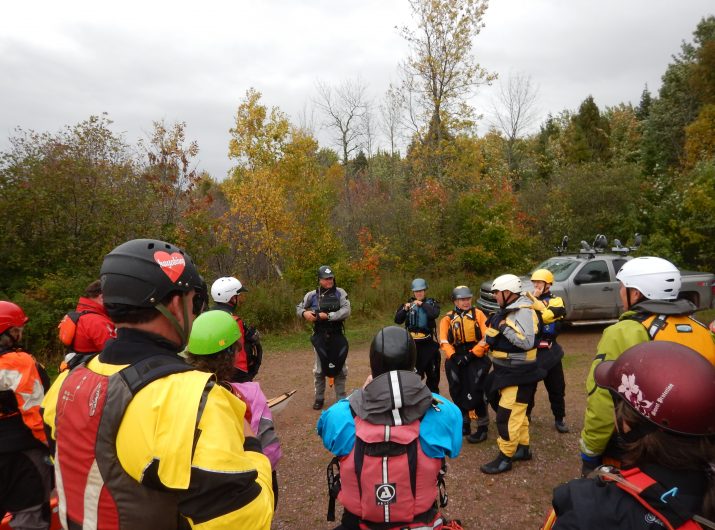
This past weekend was the annual MEC Toronto Paddlefest and once again it was a hugely successful event with over 618 people pre-registered and approximately 120 people walking in and registering on the spot. That doesn’t include the 60 or so instructors, boat helpers and staff running around keeping the machine running smooth. With those numbers, it’s easily one of the biggest events of its kind in
This year I had the pleasure to teach a bit on the water but to also teach a bunch of on-land sessions including weather, navigation and technology in the wilderness. Over the years I have taught lots of symposium kayak sessions so it’s sometimes a nice change for me to get out and stand on dry-land every once in a while.
This was the first time that I was asked to run a session on technology in the wilderness and they wanted me to talk about personal locator beacons as well as more recreational focused devices like the SPOT or the Delorme inReach. I decided to expand the session topic a bit and try to put this technology in a bit more context by also exploring the Canadian Search and Rescue (SAR) system and explain to people how that monster works and what exactly happens when you hit that SOS button or activate your PLB. It made it a bit more interesting then just listening to a sales pitch about gear as you could get that by going to your local store and talking to the sales lady.
Of course teaching and running clinics are fun; but for me the real attraction of the weekend is hanging out with the other instructors who come into
Special thanks for Mountain Equipment Co-Op for putting on the event once again.
Here is a mini slideshow of some of the photos I took over the weekend:
Blogger and friend of the site, Bryan Hansel from paddlinglight.com is currently taking pre-orders for an awesome t-shirt he got designed.
You need to purchase one of these shirts. Just think of it as a public service announcement for your friends to get prepared because when our zombie overloads finally descend it will be too late for everybody.
This whole zombie swimming thing originally came out of a post I did back a year ago where I fantasized about somebody making a t-shirt so I’m glad Bryan came through for us. Shortly after I posted the original article, a paddling/hiking shop in Kitchener,Ontario got famous for 3 minutes when their store marquee was featured on the Fail/Win! Blog.
Bryan’s black t-shirts with white ink are selling for $16.99 with $6 shipping to U.S. addresses. If you live outside the U.S of A, contact Bryan and he will let you know shipping costs.
Order it here.
Trolling through the US patent office for kayaking related inventions is a bit like wandering around the Island of Misfit Toys. While some patents have been issued for products that have been introduced to the market, a huge number of patents have been issued for inventions that...well...most likely will name make it to your local paddling shop.
Here are a couple highlights that I found:

In 2004 a patent was issued for this Emergency Air System for Kayaks. In theory it seems like a good idea for whitewater paddlers but according to the filing, it was going to be intended for paddlers who fail their roll the first time and need another breath before trying again.

Here is somebody who invented what could be called the worlds most complicated hydration system for kayaking. It involves a bladder that held water behind your seat followed by a series of tubes through the deck of your kayak and up to your mouth. This was unique because of a squeezable bulb (mounted between your legs) which would be used to pressurize the bladder. No sucking for you!

I don’t know a single person who hasn’t said that they wished their kayak deck came with a set of luggage racks so I have no idea why manufactures didn’t jump all over this invention. Just think of the junk luggage I could have taken on trips if this patent from 1993 had come to market.


Speaking of people who like to bring lots of stuff, here is the perfect accessory for your next camping trip. This Buoyant Storage Vessel comes with its own cooler, gas powered stove and yes, a kitchen sink.
Looking at the filing, I couldn’t figure out how it would work in real life. Picture this, you get to your campsite at the end of a long day and then you are expected to drag it up on the beach to use it as a portable kitchen. Let’s hope that you have the 13-14 feet treeless, flat ground available at your campsite or else the whole thing is pointless. Even if you did have the space, the whole thing seems a touch unnecessary.

And finally the weirdest (so far) that I could find is described as, “an apparatus for use in evaluating paddled watercraft.”
From what I can tell, it’s a device designed to sit on the paddleshop floor that would allow a customer to get a feel for how a kayak would handle on the water without actually needing to be on the water. Not sure exactly how it works but it seems to have a series of rollers enabling you to test its stability side to side. How is this not in all shops!?
Did any of these items ever actually make it to market in a slighty different form? Let me know in the comments.
If you are like me you probably don’t have a lot of space in your living room to start building a 17 foot kayak.
To help solve that problem, Jöns Aschan from paddlingsfabriken.fi developed a papercraft kayak available for download. All you need to do is carefully cut out all the pieces with a pair of sharp scissors and tape it all together (just like the real thing). The price is €2.00 ($2.65US) and it works best if you can print it out on thick stock paper.
Looks like a great rainy afternoon project for sure.

Roger Zahradnik from
Roger quickly turned around but by the time he was able to get back to the boat it had already been stolen by vehicle also going in the same direction on the highway.
According to the Door County Advocate, police are looking for a white box truck seen in the area carrying a stolen green Wilderness Systems Pungo in the back.
Ahh the Pungo. That classic kayak that was so popular to make fun of via online video from xtranormal.com a while back.
Well here is one for the books.
A man in a kayak (not the guy in the stock photo above) in Mesick, Michigan was stopped by officers of the Department of Natural Resources doing safety equipment check on small boats. They told the paddler he needed a PFD but the man replied that he had enough paddling skills and was adamant he didn’t see a lifejacket. Never had, never would.
You can see where this is going.
The officers let the guy go with a warning only to have to rescue him moments later when he flipped his kayak in the 51-degree water.
After pulling the man into their boat and taking him to shore to warm-up they promptly wrote him a ticket for failure to wear a lifejacket.
You can read the full story here.
You can't make that stuff up!
Flickr photo credit: http://www.flickr.com/photos/celloc/2922098608/ - http://creativecommons.org/licenses/by/2.0/deed.en_CA